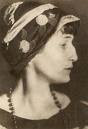
The death of Miss Emily
E. Dickinson, daughter of the
late Edward Dickinson,
at Amherst on Saturday last
makes another sad inroad
upon the small circle so long
occupying the old family mansion.
It was for a long generation over-
looked by death, and one in
passing in and out there, could
but think of old fashioned times,
when parents and children
grew up to and passed maturity
together, in lives of singular
uneventfulness, unmarked by
sad or joyous crises. Very few in the
village knew Miss Emily per-
sonally, except among the older
inhabitants, although the fact
of her seclusion and intellectual
brilliancy was one of the familiar
Amherst traditions. There are many homes
among the classes into which
her treasures of fruit and
flowers and almost ambrosial
dishes for the sick and well
were constantly sent, that will
forever miss those dainty traces
of her unselfish devotion and be
moved afresh that she screened
herself from closer acquaintance.
As she passed on in life, her
sensitive nature shrank from much
personal contact with the world,
and more and more she turned
to her own large wealth of
individual resources, for companion-
ship – sitting henceforth, as some
one said of her, "In the light of
her own fire". Not disappointed
with the world, not an invalid
till within the past two years – not from
any lack of all embracing love,
and sympathy – not because she
was insufficient for any mental
work, or social career, her en-
dowments being so exceptional,
but the "mesh of her soul" as
Browning calls the body, was too
rare, and the sacred quiet of her
own home proved the native at-
mosphere for her worth and
work. All that must be inviolate.
One can only speak of
"Duties beautifully done" – of her
gentle tillage of the rare flowers
filling her conservatory, into
which, like the heavenly Paradise,
entered nothing that could
defile, and which was ever
abloom in frost or sunshine, so
well she knew her chemistries –
of her gentle tenderness to all
in the home circle – her gentle-
woman's grace, and courtesy to
all who served in house, and
grounds – of her quick rich re-
sponse to all who rejoiced, or
suffered at home, or among her
wide circle of friends the world
over. This side of her nature was
to her, the real side – this, the
entity in which she rested, so
simple and strong was her instinct
that a woman's hearth-stone is
her shrine. Her talk and her
writings, were like no one else,
and although she never published
a line, now and then some en-
thusiastic literary friend, would
turn love to larceny, and cause
a few verses surreptitiously obtained,
to be printed. Thus, and through
other natural ways, many saw
and admired her verses, and
in consequence frequently
notable persons paid her visits,
hoping to overcome the protest
of her own nature and gain a
promise of occasional contri-
butions at least to various
magazines. She withstood
the fascinations of Helen Jackson
who earnestly sought her
co-operation in a novel in
the "No Name Series", although
one little poem strayed in
some way into the volume
of verses in that edition.
Her pages would illy have
fitted even so attractive a
story as "Mercy Philbrick's
Choice", unwilling as the
public are to believe she
had no part in it: "Her
wagon was hitched to a star"
and who could ride or write
with such a voyager.
A Damascus blade
gleaming, and glancing
in the sun was her wit.
Her swift poetic rapture
like the long glistening
note of a bird one hears
in the woods in June at high noon,
but never can see. Like
a magician she caught
the shadowy apparitions of
her brain and tossed them
in startling picturesqeness
to her friends, who charmed
with their simplicity and
homeliness, as well as pro-
fundity, fretted that she
had so easily made palpable,
the tantalizing fancies forever
eluding their bungling
fettered grasp. So intimate
and passionate, her love of
Nature, she seemed herself a part
of the high March sky – the
Summer day and bird call.
Keen and eclectic in her
literary tastes, she sifted
Libraries to Shakespeare and
Browning – quick as lightning
in her intuitions, and analyses,
she seized the kernel in-
stantly, almost impatient
of the fewest words by which
She must make her revelation.
So her life was rich, and
all aglow with God and
immortality – with no creed –
no formulated faith, hardly
knowing the names of dogmas
she walked this life, with
the gentleness and reverence
of old saints, with the firm
step of martyrs who sing
while they suffer. How better
note the flight of this "Soul
of fire in a shell of pearl"
than by her own breathings
Morns like these, we parted
Noons like these, she rose.
Fluttering first, then firmer
To her fair repose.
May I trouble you dear
Sam to pardon untidyness of
this, for I am weary and sick.
Also to return this.
As ever yours – S.H.D
Will you have "gentlewoman"
printed as one word? not
with a hyphen –
Saturday, 7 January 2012

Thursday, 5 January 2012
Retour de la pêche aux huîtres
Bivalve women,
You gave me bones
And twisted this from
Sally-rods & withy. Fishers
Of men. Proud hips and
Bellies swallow us, belie a
Fictive swarm, the sunlit
World before, trees,
Shore and seas, the islands
Into sky. Thin vision-tissue, gently
Torn – that lighthouse, and the glare
Off sleek and swollen
Waves, white light of empty God
Behind the scene.
You gave me bones
And twisted this from
Sally-rods & withy. Fishers
Of men. Proud hips and
Bellies swallow us, belie a
Fictive swarm, the sunlit
World before, trees,
Shore and seas, the islands
Into sky. Thin vision-tissue, gently
Torn – that lighthouse, and the glare
Off sleek and swollen
Waves, white light of empty God
Behind the scene.
Tuesday, 27 December 2011
Я - Ахматова

For years I confused Saints Dominic and Bernard, to the grave detriment of my relationship with the latter's substantial & sparkling presence in The Perennial Philosophy. Sunset at Oak Hill Cemetery in Brewer, god-bodkin blood leaking up under black trees' bared teeth in the middle distance: Flannery O'Connor. Fannie Hardy Eckstorm is buried here, somewhere under all this Christmas snow. I can't find her today, my usual knack (which brought me & my bike pauselessly direct to Timothy Swan's white obelisk back in October, Northfield) falters. Walking the Joshua Chamberlain bridge back over the Penobscot Bangorward I'm singing "Kwe ya he no" and thinking on poor Jael Hilderbrand of Pleasant Point.
Tuesday, 6 December 2011

Saturday, 26 November 2011
Gemmage des Pins, autrefois
The soil is clay and its surface is wet everywhere, even the high ground, even after many nights of stars and wind. The river is huge and expressionless; the mountain-shapes that rise on its nether bank are only shapes, without the Gaudier-Brzeskan sculptural energy that inheres to our mountains. Anne Sexton and Sylvia Plath drink martinis together in Boston, wanting to die. I corral language-powers into the various strands of my correspondence. These two things are common between Frank Speck and me: a working knowledge of modern Greek, and that "penny postcards comprise the larger part of his literary remains". Strunk & White say the period should go inside the quotation marks in this and any other case; I'm afraid British usage feels much more correct to me on this point. Minor treason. What a golden flower was Manhattan Island this morning. I walked buoyantly through it in spite of having been drinking last night till three with Raymond Marunas's ghost. The carillon at Grace Church on Broadway broke into sudden cumbrous song around noon, staggering in and out of key with massive clangor; it was the stone of the church itself that was ringing, and we were all rising with it into the richer light. On Fourth Avenue I handled but did not buy a clean copy of the 1955 Poems (E.D.), one hundred dollars. How many skulls around my neck already. These thick textures of māya, punctured and sewn; unsewn; reassembled in their original order by matching up the paper's stress-marks and stains.
Friday, 18 November 2011
Oakland Ave

Your two Julia Child volumes pressed up against my Paul Robeson 78s; the silver coil of the stove-door handle; your Canadian guitar; the rug from my brother's boyhood; the socks you knit me.
Wednesday, 16 November 2011

Saturday, 12 November 2011
Black Book
Spanish bullseye: Diana.
NYRB: "Cavafy, a happy practicioner of samizdat..."
Genetic event of apple extends into time by persistence of tree life, or by human grafting culture, or by a rootsucker's taking over from dead or moribund tree.
"Numb as a hake," old downeast language.
1804 1 billion
1927 2 billion
1960 3 billion
1974 4 billion
1987 5 billion
1999 6 billion
2011 7 billion
Julia says it's obvious why no one ever talks about it.
Picking with Jason: springtime snowmelt thrills, ripe autumn's fruit.
The finite Atom infinite
That forms thy circle's centre-dot
Cerebral/spinal/genital matter one continuum.
Peggy on tofu: "It was like chicken but it wasn't chicken it was that other stuff they use."
Columbus card traditionally played as triumph of reasoning cognition over murky phantasms of medieval concept of world; in fact Admiral C. (in name & spirit of dull, blind, protocapitalist prerogatives of the flat world) ruptured stale certainties of boundaried "known" of Europe and precipitated its opening to wonder. (Weschler's book on Museum of Jurassic Technology)
"The pathologists recommend a prebloom schedule involving a tank mix of mancozeb at 3 pounds per acre plus captan-80 at 1.5 to 3 pounds per acre."
Non's fitt to live
But who is fitt to die
NYRB: "Cavafy, a happy practicioner of samizdat..."
Genetic event of apple extends into time by persistence of tree life, or by human grafting culture, or by a rootsucker's taking over from dead or moribund tree.
"Numb as a hake," old downeast language.
1804 1 billion
1927 2 billion
1960 3 billion
1974 4 billion
1987 5 billion
1999 6 billion
2011 7 billion
Julia says it's obvious why no one ever talks about it.
Picking with Jason: springtime snowmelt thrills, ripe autumn's fruit.
The finite Atom infinite
That forms thy circle's centre-dot
Cerebral/spinal/genital matter one continuum.
Peggy on tofu: "It was like chicken but it wasn't chicken it was that other stuff they use."
Columbus card traditionally played as triumph of reasoning cognition over murky phantasms of medieval concept of world; in fact Admiral C. (in name & spirit of dull, blind, protocapitalist prerogatives of the flat world) ruptured stale certainties of boundaried "known" of Europe and precipitated its opening to wonder. (Weschler's book on Museum of Jurassic Technology)
"The pathologists recommend a prebloom schedule involving a tank mix of mancozeb at 3 pounds per acre plus captan-80 at 1.5 to 3 pounds per acre."
Non's fitt to live
But who is fitt to die
Wednesday, 19 October 2011


Tuesday, 18 October 2011
Black Book
Charles Leland, 1884: "Nothing is so contemptible in Indian eyes as a want of dignity and idle, loquacious teasing; therefore it is made in the myth the sin which destroyed their race. The tendency of the lower class of Americans, especially in New England, to raise and emphasize the voice, to speak continually in italics and small and large capitals, with a wide display, and their constant disposition to chaff and tease, have contributed more than any other cause to destroy confidence and respect for them among the Indians."
Demetrios Latchis from Καστάνιτσα to Hinsdale, 1901.
"Saupoudrez les pommes de sucre et parsemez-les de noisettes de beurre."
John Abbot was in Jacksonborough, Scriven County, Georgia. "All traces of this old town have now passed away."
"Trust not in uncertain Riches, but in the Living God."
Odzihozo turned himself into Rock Dunder.
Scudder calls the endearing Lycaenid habit of rubbing together the hind wings a "presumed stridulation".
New Sweden 1638 at the mouth of the Delaware River.
Father John Babst on Indian Island, middle 19th century, a true christian.
Haincty/dicty.
William Wood on oysters in New England's Prospect: "This fish without the shell is so big, that it must admit of a division before you can well get it in your mouth."
Alewives, shad, salmon anadromous; eels catadromous.
Detroit Greeks: feather bowling.
Networking within the nationwide Indian entertainment industry of the late 19th century seeded the general Native American Consciousness movement of the late 20th century.
People not enjoying conversation; listening only in ego-tension and defensively; stopping up any gap with further self-babble.
Banana esters.
Dedham schoolyard: "An evil plot to kill Mr. Winters."
Fannie Hardy Eckstorm: "He would have broken all the commandments seriatim if that would have helped the logs along."
Kateri Tekakwitha's village was in present-day Ayriesville, NY. She moved to Caughnawaga in the 1670s. Venerable in 1943; canonized 1980.
The Presumpscot formation. Marine clay; blanket of fine-ground gracial silt. Tempered with rocks or vegetable fibre and worked into cookpots with dentate decoration and a pointed bottom so as to sit in bed of fire.
The alternate reality reigning in African cities where charitable organizations have sent the T-shirts that were printed up with the wrong Superbowl or electoral results.
Bruce: "I've come to be very much against zoos. The only thing I ever liked in a zoo, ever, was a seal in Pittsburgh one time."
In 1876 John Ross and his (Penobscot) West Branch Drive were contracted to take all the logs on the Connecticut from headwaters to Hartford during a severe drought.
Beethoven opus 132: Hurdy-Gurdy.
"I am death, who distributes the fruit of all action."
“Bessie Smith was the one Classic Blues artist to outlive the genre, the one artist whose work justifies the entire style.”
It is sown in Weakness
It is raised in Power
Demetrios Latchis from Καστάνιτσα to Hinsdale, 1901.
"Saupoudrez les pommes de sucre et parsemez-les de noisettes de beurre."
John Abbot was in Jacksonborough, Scriven County, Georgia. "All traces of this old town have now passed away."
"Trust not in uncertain Riches, but in the Living God."
Odzihozo turned himself into Rock Dunder.
Scudder calls the endearing Lycaenid habit of rubbing together the hind wings a "presumed stridulation".
New Sweden 1638 at the mouth of the Delaware River.
Father John Babst on Indian Island, middle 19th century, a true christian.
Haincty/dicty.
William Wood on oysters in New England's Prospect: "This fish without the shell is so big, that it must admit of a division before you can well get it in your mouth."
Alewives, shad, salmon anadromous; eels catadromous.
Detroit Greeks: feather bowling.
Networking within the nationwide Indian entertainment industry of the late 19th century seeded the general Native American Consciousness movement of the late 20th century.
People not enjoying conversation; listening only in ego-tension and defensively; stopping up any gap with further self-babble.
Banana esters.
Dedham schoolyard: "An evil plot to kill Mr. Winters."
Fannie Hardy Eckstorm: "He would have broken all the commandments seriatim if that would have helped the logs along."
Kateri Tekakwitha's village was in present-day Ayriesville, NY. She moved to Caughnawaga in the 1670s. Venerable in 1943; canonized 1980.
The Presumpscot formation. Marine clay; blanket of fine-ground gracial silt. Tempered with rocks or vegetable fibre and worked into cookpots with dentate decoration and a pointed bottom so as to sit in bed of fire.
The alternate reality reigning in African cities where charitable organizations have sent the T-shirts that were printed up with the wrong Superbowl or electoral results.
Bruce: "I've come to be very much against zoos. The only thing I ever liked in a zoo, ever, was a seal in Pittsburgh one time."
In 1876 John Ross and his (Penobscot) West Branch Drive were contracted to take all the logs on the Connecticut from headwaters to Hartford during a severe drought.
Beethoven opus 132: Hurdy-Gurdy.
"I am death, who distributes the fruit of all action."
“Bessie Smith was the one Classic Blues artist to outlive the genre, the one artist whose work justifies the entire style.”
It is sown in Weakness
It is raised in Power
Saturday, 8 October 2011

Tuesday, 20 September 2011
“I never travel without my diary; one should always have something sensational to read on the train.”
Trains were more dangerous in those days. Not that there were more accidents – in fact there were far fewer. What was in danger was rather a body's sense of its own limits; its simple, unproblematic position within time and space. For every train-car that clacked its wheels over the seams that punctuated the rails just across from the grassy, trashy spot outside Athens where I used to loiter aspiringly near the crouching knots of gypsies, my heart had an ache. For every ache my heart had, ten butterfly worms complied with their ancient tendency and took on powdery wings.
Tuesday, 30 August 2011

Sunday, 28 August 2011
Tuesday, 9 August 2011
HOP MERCHANTS
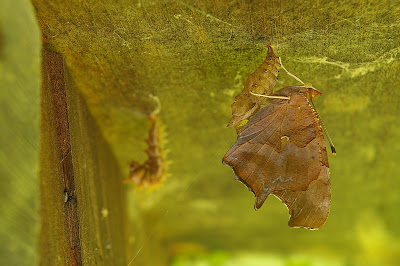
Filter of broad Humulus leaves hazes the shade greenish.
Leaves well addled with caterpillar jaw-work are auspicious of good hop crop.
In the foreground a freshly fledged Polygonia interrogationis, opening questions: it has not yet opened its wings, not even once; how many times in its life will it open its wings?
(Zoom in to notice its namesake silvered punctuation-mark, imperfectly printed.)
In the background a larval sibling, having stitched its foot to the eave, assumes the asana and begins the breathing exercises that will bring it a hard chrysalid shell; this container (you can see one there, the empty husk out of which the adult has crawled and upon which it still hangs, resting) will allow for total self-liquidation.
Liquid will reorganize itself over the course of a week or two and come out butterfly.
Schmetterling is built on an etymological energy of "smashing": the butterfly is like a fluttering piece of debris. English has an old word for this, "flinder"; this word too has carried butterfly senses (hence the archaic "flinder-mouse" for bat, cognate with German Fledermaus). Some scholars suggest "butterfly" to be a popular-etymology corruption of the unattested "batterfly".
Friday, 22 July 2011
Dear Daniel
Good to hear from you. The Propertius is true (Vincent Katz; you had espressos with him this morning over by the Palazzo Barberini) but the Paros is not. I can't believe you're in Roma, amazing. I spent one day there, once. Even just the thought of Italy makes me swoon (I'm boring that way).
According to my sources Roosevelt got Polio on Bear Mountain, up the Hudson.
I'm still in Maine; my life here very full. It's felt good to be based in one place for so long (since early February). I've been reading a lot – mostly on Maine Indian matters. Frank Speck, Fannie Hardy Eckstorm, Bunny McBride, Harald Prins: all your old favorites. Also on New England gravestone carving (Peter Benes, Ted Chase & Laurel Gabel, etc.), continuing that affectionate passion. I've become something of a New Englander. I realized recently what it is I've done: After scattering myself abroad and snagging my teeth hungrily on some of the wonderful things of latin american and various european worlds, lodging my heart in fibres of multiple shores & languages and feeling all the heartstring-stretching aches attendant to such promiscuous connection, I've contracted: into a more manageable economy of enthusiastic engagement. MASSACHUSETTS, for example, is to me now as saturated a text as the Mani; believe it or don't; I can hardly believe it myself; it's altogether true. And exceedingly convenient, for me, considering my whereabouts and my economic station. I commend myself on having (blindly, instinctively) cultivated this situation. It reminds me of when I got so much into AKVARIUM that I could authentically indulge my youthful record-store-consumer psychology in Brighton Beach where CDs only cost two dollars. A little excursion to some Connecticut River Valley village or Plymouth county graveyard can satisfy my hungers now as much as a train-ride to Monemvasia – and can be much more easily arranged. Of course the language element – that particular pleasure – is missing here; though I speak mexican in the strawberry fields (was picking strawberries the past couple weeks) and am considering going into Passamaquoddy.
I need to close here – things to get to –
but yes let's try & be more in touch; I'm delighted to think of you there and in France.
Bruce is well, but in slow decline and not relishing the prospect of my absence (for appling) in september.
Julian found true love, long hungered-for; a young man in New York who works for the Film Forum (and has "gratis + 1" at any cinema in the city). The whole paradigm around Julian's uneasy wordly ambitions for the Music Tapes has undergone a welcome shift consequent to this. Where there was a manic tangle of touring possibilities & record promotion etc. there's now a saner, gentler tangle which stresses less at the boundaries of my own quiet life. I've just today written to Stan & Jenny to commit to apples; I think that might cut me out of some touring activities; but all will be well and all manner of thing shall be well.
I send love to you and yours. L'anniversaire du petit Anatoly s'approche.
Hope I can see you all sometime.
your
Ian
Good to hear from you. The Propertius is true (Vincent Katz; you had espressos with him this morning over by the Palazzo Barberini) but the Paros is not. I can't believe you're in Roma, amazing. I spent one day there, once. Even just the thought of Italy makes me swoon (I'm boring that way).
According to my sources Roosevelt got Polio on Bear Mountain, up the Hudson.
I'm still in Maine; my life here very full. It's felt good to be based in one place for so long (since early February). I've been reading a lot – mostly on Maine Indian matters. Frank Speck, Fannie Hardy Eckstorm, Bunny McBride, Harald Prins: all your old favorites. Also on New England gravestone carving (Peter Benes, Ted Chase & Laurel Gabel, etc.), continuing that affectionate passion. I've become something of a New Englander. I realized recently what it is I've done: After scattering myself abroad and snagging my teeth hungrily on some of the wonderful things of latin american and various european worlds, lodging my heart in fibres of multiple shores & languages and feeling all the heartstring-stretching aches attendant to such promiscuous connection, I've contracted: into a more manageable economy of enthusiastic engagement. MASSACHUSETTS, for example, is to me now as saturated a text as the Mani; believe it or don't; I can hardly believe it myself; it's altogether true. And exceedingly convenient, for me, considering my whereabouts and my economic station. I commend myself on having (blindly, instinctively) cultivated this situation. It reminds me of when I got so much into AKVARIUM that I could authentically indulge my youthful record-store-consumer psychology in Brighton Beach where CDs only cost two dollars. A little excursion to some Connecticut River Valley village or Plymouth county graveyard can satisfy my hungers now as much as a train-ride to Monemvasia – and can be much more easily arranged. Of course the language element – that particular pleasure – is missing here; though I speak mexican in the strawberry fields (was picking strawberries the past couple weeks) and am considering going into Passamaquoddy.
I need to close here – things to get to –
but yes let's try & be more in touch; I'm delighted to think of you there and in France.
Bruce is well, but in slow decline and not relishing the prospect of my absence (for appling) in september.
Julian found true love, long hungered-for; a young man in New York who works for the Film Forum (and has "gratis + 1" at any cinema in the city). The whole paradigm around Julian's uneasy wordly ambitions for the Music Tapes has undergone a welcome shift consequent to this. Where there was a manic tangle of touring possibilities & record promotion etc. there's now a saner, gentler tangle which stresses less at the boundaries of my own quiet life. I've just today written to Stan & Jenny to commit to apples; I think that might cut me out of some touring activities; but all will be well and all manner of thing shall be well.
I send love to you and yours. L'anniversaire du petit Anatoly s'approche.
Hope I can see you all sometime.
your
Ian
Wednesday, 20 July 2011
The use of a pronoun – gendered or no – when referring to God is neither safe nor useful.
 Old John Neptune, recorded by Thoreau: "Moose was whale once. Away down Merrimack way, a whale came ashore in a shallow bay. Sea went out and left him, and he came up on land a moose."
Monday, 18 July 2011


Thursday, 30 June 2011
Black Book
Hollywood gives us two plumbers: Rosscoe Arbuckle, plumber from Hell, plumber who should have stayed plumber, Lucifer-plumber, plumber who climbed too high & plumbed too deep; and Cluny Brown, lovely lively Jennifer Jones in elegant froth of Lubitsch's last film which is a distillate in spite of itself of all his good world, and she the best good plumber, the unstopper of drains, the angel of flush and of flow.
McGee: Espresso debuted at Paris Expo 1855. The pressure extracts & emulsifies oils making for velvet & foam of well-pulled shot. Pu-erh: "All of its Phenolic contents are converted into nonastringent thearubigens and brown complexes."
Wheeler saw featured as tool-of-the-month in Martha Stewart Living, Feb. 2001. Made by OESCO Inc., Conway Mass; first made in Belchertown ca. 1945
Webster: "NINE, noun. The number composed of eight and one; or the number less by a unit than ten; three times three."
Ojibwa and Potawatami bands from around Great Lakes deployed 1200 warriors against New York and New England during the War of the Austrian Succession, 1744-48.
It is through la pauvreté, l'échec, et la mort that we draw near to God.
Emily Dickinson. The Johnson numbers come easily to us; we to whom come easily also her common meter and hymnic register, we living residues of the psalming system that was her template.
Gypsy slot filled for Eurofolk on Mount Desert by Wabanaki with baskets & fortune-telling.
Bruce in Dedham reading comic book while riding bike, got in a terrible accident: hit from behind, a hit & run! Left me for dead! Kid found me brought me home, I said to my sister, "Don't tell Mother!"
Max Hastings on Patrick Leigh Fermor: "Wearing his literacy light as wings, brimming over with laughter."
Elizabeth Coane Goodfellow arrived in Philadelphia 1806, credited w/inventing Lemon Meringue Pie.
Tide turned just before the Congo church struck two – boats moored at the river's mouth were bow-upstream; they moved slowly upriver, reached the resistance of their moorings, turned.
Jeanne d'Arc: "Pensez vous que nostre seigneur n'ait de quoy les vestir?"
In Milton's cardboard heaven: Transpose theological reality into time, i.e. into "Greek Mythology".
Bruce: Alice and I were just barefooted kids, in our twenties – invited to a party at Domenico's tower – we walked around the tower, and Domenico is there with this most beautiful woman – Alice was so impressed – and we could hear them softly speaking Italian – (stopped by quiet tears)
Frank Speck: the "bush economy" of long hunting trips provides a space for the survival of pre-contact material culture.
Perch, flounder, smelt, skate, dab, plaice, pout, scup.
"In prayer he did not stop at the frontiers of his knowledge and his reasoning. He adored God and God's mysteries as they are in themselves and not as he understood them."
"Charles Quincy Goodhue (1835-1910) spent the last twenty years of his life sketching Portland as it had looked before the fire of 1866."
Bruce: "Jones is a Welsh name, know what it means? Smith."
Phineas Parkhurst Quimby hangs out his shingle in Belfast, Maine, 1847: "Clockmaker, Mesmerist, Healer, Daguerrian Artist."
Mother Ann: "Sweep clean."
Peter Benes's crazy science: Plymouth County "geometric" designs represent embryonic angels; late-century explicit angel facialization is post-resurrection imaging of same "after their translation into time-resistant celestial beings".
Moose are like whales.
McGee: Espresso debuted at Paris Expo 1855. The pressure extracts & emulsifies oils making for velvet & foam of well-pulled shot. Pu-erh: "All of its Phenolic contents are converted into nonastringent thearubigens and brown complexes."
Wheeler saw featured as tool-of-the-month in Martha Stewart Living, Feb. 2001. Made by OESCO Inc., Conway Mass; first made in Belchertown ca. 1945
Webster: "NINE, noun. The number composed of eight and one; or the number less by a unit than ten; three times three."
Ojibwa and Potawatami bands from around Great Lakes deployed 1200 warriors against New York and New England during the War of the Austrian Succession, 1744-48.
It is through la pauvreté, l'échec, et la mort that we draw near to God.
Emily Dickinson. The Johnson numbers come easily to us; we to whom come easily also her common meter and hymnic register, we living residues of the psalming system that was her template.
Gypsy slot filled for Eurofolk on Mount Desert by Wabanaki with baskets & fortune-telling.
Bruce in Dedham reading comic book while riding bike, got in a terrible accident: hit from behind, a hit & run! Left me for dead! Kid found me brought me home, I said to my sister, "Don't tell Mother!"
Max Hastings on Patrick Leigh Fermor: "Wearing his literacy light as wings, brimming over with laughter."
Elizabeth Coane Goodfellow arrived in Philadelphia 1806, credited w/inventing Lemon Meringue Pie.
Tide turned just before the Congo church struck two – boats moored at the river's mouth were bow-upstream; they moved slowly upriver, reached the resistance of their moorings, turned.
Jeanne d'Arc: "Pensez vous que nostre seigneur n'ait de quoy les vestir?"
In Milton's cardboard heaven: Transpose theological reality into time, i.e. into "Greek Mythology".
Bruce: Alice and I were just barefooted kids, in our twenties – invited to a party at Domenico's tower – we walked around the tower, and Domenico is there with this most beautiful woman – Alice was so impressed – and we could hear them softly speaking Italian – (stopped by quiet tears)
Frank Speck: the "bush economy" of long hunting trips provides a space for the survival of pre-contact material culture.
Perch, flounder, smelt, skate, dab, plaice, pout, scup.
"In prayer he did not stop at the frontiers of his knowledge and his reasoning. He adored God and God's mysteries as they are in themselves and not as he understood them."
"Charles Quincy Goodhue (1835-1910) spent the last twenty years of his life sketching Portland as it had looked before the fire of 1866."
Bruce: "Jones is a Welsh name, know what it means? Smith."
Phineas Parkhurst Quimby hangs out his shingle in Belfast, Maine, 1847: "Clockmaker, Mesmerist, Healer, Daguerrian Artist."
Mother Ann: "Sweep clean."
Peter Benes's crazy science: Plymouth County "geometric" designs represent embryonic angels; late-century explicit angel facialization is post-resurrection imaging of same "after their translation into time-resistant celestial beings".
Moose are like whales.
Saturday, 18 June 2011
Welcome to Old Town
Canoe is a Taíno word, recorded by Columbus after his initial Bahamian intercourse with these, his first Indians. The word was transmitted among the European languages as applied indiscriminately to any of the diverse boats used in the waters of the American hemisphere. (According to the same pidgin grammar, all the varied people who designed, built, and employed these boats were called Indians.) The differences between, for example, the dugout Miskito coasting duri – etymon to our Gulf of Maine banks dory – and the lightweight Penobscot birchbark agwiden were thus linguistically sublimated. James Rosier writes in 1605 of the Wabanaki Canoas; Plymouth County Court Records attribute an accidental drowning death in 1660 to a "naughty canoo". In consequence to the Northeast's becoming the locus of England's greatest successes in American colonization, and to the obvious superiorities of its ingenious portageable design, the cedar-&-birch boat of the Maine woods came eventually to eclipse all else in the semantic field "canoe". The integrity of the design was found to survive the replacement of its birchbark & sprucegum sheath with one of painted canvas, and the Old Town Canoe Co. began at the end of the 19th century to produce them this way in great quantity and to market them aggressively. Today as one enters Old Town the welcome sign reads, somewhat redundantly, "Welcome to Old Town, Home of the Old Town Canoe". Indian Island in Old Town being – and having been, from time immemorial – the axial hub of the Penobscot nation, whose agwiden is the unaltered, already-perfect prototype to our modern canoe, the sign should read, "Welcome to Old Town, Home of the Canoe".
Subscribe to:
Posts (Atom)